
Official Receipt to Invoice: What POS Users Must Do
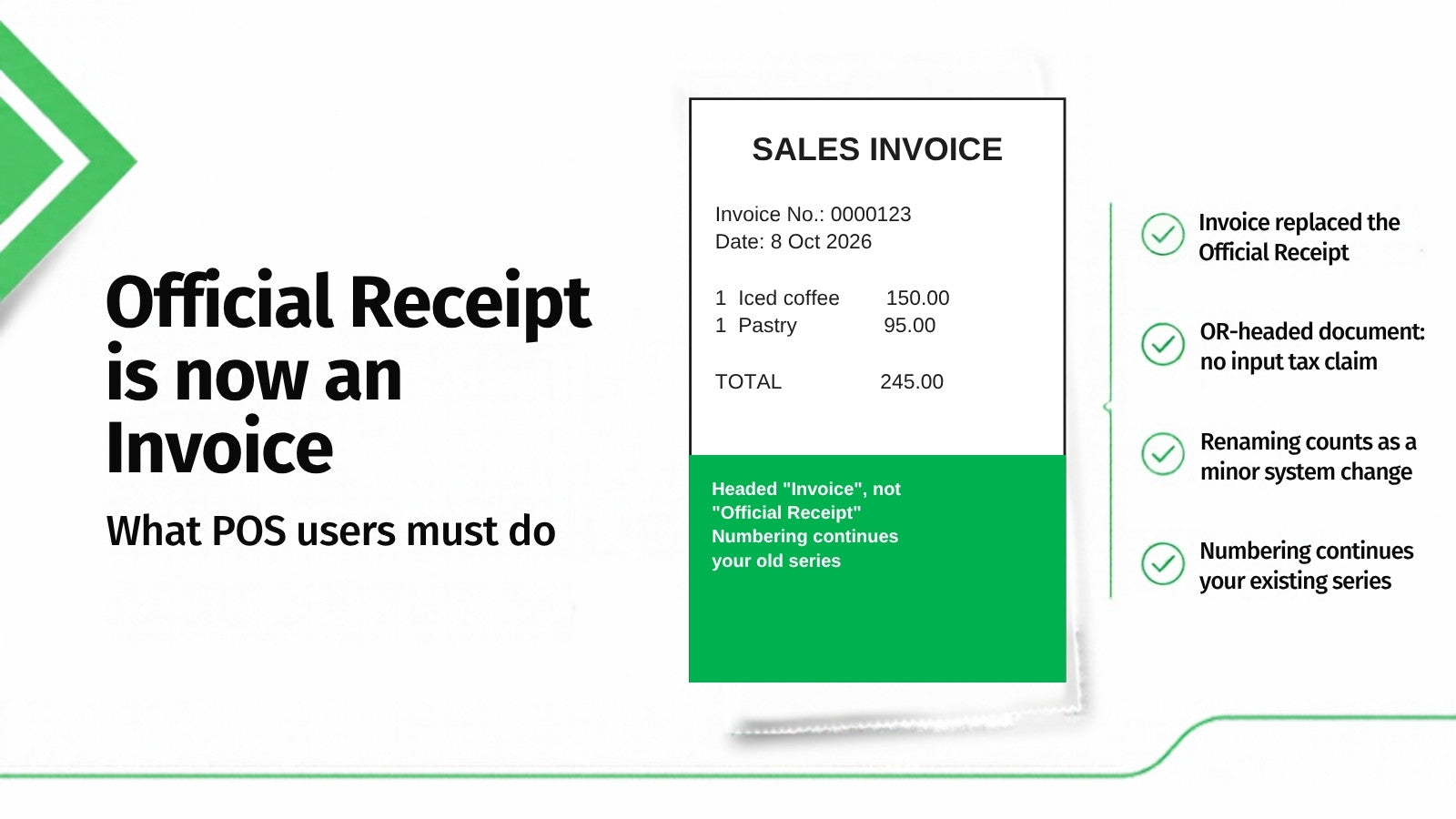
Under the Ease of Paying Taxes Act, the Invoice replaced the Official Receipt as the primary document for both goods and services. A document still headed "Official Receipt" is not valid for the buyer to claim input tax.
For businesses running CRM or POS systems, this required a system reconfiguration — one the BIR classified as a minor change, with a specific set of conditions attached. Here is what was required, what the deadlines were, and what still matters now.
What changed
Revenue Regulations No. 7-2024, issued 11 April 2024, implements Sections 113, 235, 236, 237, 238, 242 and 243 of the Tax Code as amended by RA 11976 (the Ease of Paying Taxes Act), covering registration procedures and invoicing requirements.
The core change: the Invoice became the primary document evidencing a sale. The Official Receipt — along with Collection Receipts, Acknowledgement Receipts and Payment Receipts — became a supplementary document. As RR 11-2024 puts it, those documents "serve as proof of payment that cash has been received or that payment has been collected/made for goods and/or services" — proof of payment, not proof of the sale.
The consequence is stated bluntly in RR 7-2024: documents issued by CRM/POS, e-receipting or electronic invoicing software containing the word "Official Receipt" from the effectivity of the regulations "shall not be considered as valid for claim of input tax by the buyer/purchaser."
For a B2B seller, that is not a filing technicality. It means your VAT-registered customers cannot claim input tax on what you issued them.
What POS users had to do
Three requirements, and the second is the one that trips people up.
1. Rename the document in the system. Taxpayers using CRM/POS may rename "Official Receipt" to "Invoice", "Cash Invoice", "Charge Invoice", "Credit Invoice", "Billing Invoice", "Service Invoice", or any name describing the transaction.
2. Continue the existing serial series. The renamed Invoice must carry on the last series used for the Official Receipt — not restart at 001. A notice of the starting serial number is filed with the RDO in duplicate.
3. Notify after reconfiguration. Submit notice on completion of the reconfiguration or enhancement, indicating the details, within the prescribed period.
No re-accreditation, no new Permit to Use. RR 7-2024 is explicit that the rename "shall not require the reaccreditation of sales software/system on the part of the software supplier nor the reissuance of the Permit to Use on the part of the taxpayer-user." RR 11-2024 confirms the reconfiguration "shall be considered as minor."
That classification matters. Under RMO 24-2023, a major enhancement would have required a fresh accreditation application with a comparative feature matrix. Treating the rename as minor is what made the transition manageable.
The deadlines, and what they mean now
Revenue Regulations No. 11-2024, issued 13 June 2024, amended the transitory provisions of RR 7-2024:
| Item | Deadline |
|---|---|
| CRM/POS reconfiguration | 31 December 2024 |
| Extension, if approved | No longer than six months from 31 December 2024 |
Any extension required approval from the Regional Director or the Assistant Commissioner, Large Taxpayers Service. Notice of completion was due within the prescribed number of days from finishing the reconfiguration, or by 31 December 2024, whichever came first.
These dates have passed. If your system still issues documents headed "Official Receipt", that is a live compliance problem now rather than a transition still in progress — and worth raising with your vendor and your RDO promptly.
Unused pre-printed receipts
RR 11-2024 gave two options for stocks of manual and loose-leaf Official Receipts already printed. Both remain useful to understand, because businesses still surface old stock.
Option 1 — use them as supplementary documents. Permitted until fully consumed, provided the phrase is stamped on the face of the document:
"THIS DOCUMENT IS NOT VALID FOR CLAIM OF INPUT TAX."
Option 2 — convert them into Invoices. Strike through the words "Official Receipt" and stamp "Invoice", "Cash Invoice", "Charge Invoice", "Credit Invoice", "Billing Invoice", "Service Invoice", or a name describing the transaction.
Converted documents are valid for the buyer's input tax claim for the period issued from 27 April 2024 until fully consumed — provided the stamp is present and none of the information required under RR 7-2024 is missing. Where the old form lacks required fields, that information "may also be stamped if not originally indicated." Quantity, unit cost and description or nature of service must be present, per Section 237 of the Tax Code.
And the default position, stated plainly:
"Effective April 27, 2024, any manual/loose leaf 'Official Receipts' issued without a stamped 'Invoice' will be considered supplementary documents… and ineligible for input tax claims."
One clarification worth noting: RR 11-2024 also states that stamping does not, by itself, do everything — the converted document still has to carry the required information. A stamp on an inadequate form does not rescue it.
What an Invoice has to contain
The renaming is the visible part; the content requirements are what actually determine validity. Under RR 7-2024, a VAT Invoice must carry the information set out in the regulation, and for POS-generated documents this sits alongside the requirements already imposed by RMO 24-2023 — including, at the bottom of every document:
"Name, Address and TIN with 5-digit Branch Code of the accredited supplier of sales machines; Accreditation number and the date of accreditation (date issued and valid until) of the accredited supplier; and PTU Number and the Date Issued or Authority to Generate (ATG) Control Number."
A quick check you can run today: print a document from your own system and confirm three things — that it is headed "Invoice" (or another permitted variant) rather than "Official Receipt", that the serial number continues your historical series rather than restarting, and that the supplier accreditation block is present at the bottom. Those three take a minute and cover the most common failure points.
Why the change was made, and the consequence worth asking about
The rename looks cosmetic. It is not — it reflects a substantive shift in what triggers the VAT.
Under the old arrangement, the Official Receipt was the primary document for services, and the Sales Invoice for goods. Because the OR evidenced payment received, VAT on services effectively followed collection. Under the Ease of Paying Taxes Act, the Invoice is primary for both, which aligns the treatment of goods and services on a single document issued at the point of sale.
For a business selling services, this is a change in timing, not just terminology — the document that triggers the output VAT is now the Invoice rather than the receipt of payment. If you sell services on credit, that is a cash-flow question worth putting to your accountant explicitly: when does the VAT become due, and what happens if the customer pays late or not at all? The EOPT Act contemplates relief for uncollected receivables, and the mechanics of claiming it are not something to work out from a summary.
Businesses selling goods over a POS terminal — most retail and F&B — are less affected, because the invoice was already issued at the moment of sale. But if any part of your operation invoices for services on terms, it is worth confirming the treatment rather than assuming the change was only a label.
We are flagging this as a question to raise, not answering it. The detailed VAT-timing provisions sit outside the parts of RR 7-2024 covered here, and this is exactly the kind of point where a summary is a poor substitute for your accountant reading the regulation against your actual arrangements.
Senior citizen and PWD discounts
One area where the document content requirements bite daily in Philippine retail and F&B. RMO 24-2023 requires that documents show, where applicable, the customer's identification card number, the applicable discount — 5% or 20% — with a detailed breakdown including any VAT exemption, and the customer's signature.
These fields are used constantly, and they are among the first things examined in a compliance check. If a reconfiguration changed your document layout, confirm the discount fields survived it intact.
Frequently asked questions
Is the Official Receipt still valid? Not as a primary document. Under RR 7-2024 the Invoice is primary; Official Receipts, Collection Receipts, Acknowledgement Receipts and Payment Receipts are supplementary documents evidencing payment.
Can my customer claim input tax on an Official Receipt? No. Documents issued containing the word "Official Receipt" are not valid for the buyer's input tax claim. Converted manual receipts stamped "Invoice" and containing all required information are valid, from 27 April 2024 until consumed.
Did renaming require re-accreditation of my POS? No. RR 7-2024 states it required neither re-accreditation by the supplier nor reissuance of the Permit to Use, and RR 11-2024 classifies the reconfiguration as minor.
Do I restart my invoice numbering at 1? No. The renamed Invoice continues the last series used, with notice of the starting serial number filed with your RDO in duplicate.
What was the deadline? 31 December 2024, extendable by no more than six months with approval from the Regional Director or ACIR-LTS. Those dates have passed.
I still have a box of printed Official Receipts. What do I do? Either stamp them "THIS DOCUMENT IS NOT VALID FOR CLAIM OF INPUT TAX." and use them as supplementary documents until consumed, or strike through "Official Receipt", stamp an appropriate Invoice designation, and ensure all required information is present.
Why did the change happen at all — isn't it just a word? No. The Official Receipt was previously the primary document for services and the Sales Invoice for goods. Making the Invoice primary for both aligns the treatment and changes what triggers the output VAT on services — from receipt of payment to issuance of the invoice.
We sell services on credit. Does this affect when we owe VAT? Potentially yes, and it is worth raising specifically with your accountant. The document triggering output VAT is now the Invoice rather than the receipt of payment, which is a timing question for anyone invoicing on terms. The EOPT Act contemplates relief for uncollected receivables; the mechanics are not something to infer from a summary.
We only sell goods over a POS. Are we affected by that timing change? Much less so, because the invoice was already issued at the moment of sale. The renaming and content requirements still apply.
Does this have anything to do with electronic invoicing? No. This is about what your document is called and what it contains. Electronic invoicing under RR 11-2025 is a separate requirement concerning structured data transmitted to the BIR, and most POS users are not yet covered by it.
This article summarises Revenue Regulations No. 7-2024 (11 April 2024) and No. 11-2024 (13 June 2024), implementing RA 11976 (Ease of Paying Taxes Act), with reference to Revenue Memorandum Order No. 24-2023, as published by the Bureau of Internal Revenue. It is general information, not tax advice. Confirm your own position with your accountant or Revenue District Office.
Alex de Leon is the President and Co-Founder of KwikPOS, a leading POS solutions provider in the Philippines specializing in one-time-payment systems for food and beverage, retail, and service businesses.
Last reviewed: 3 September 2026.
Related reading
The document change interacts with the permissions on your machine — PTU or Acknowledgement Certificate? sets out which one a POS actually needs, and BIR POS accreditation, and why it costs nothing covers the supplier side. For the newer electronic rules, see do you actually have a 31 December 2026 deadline?
Does your POS still say Official Receipt?
KwikPOS supplies point-of-sale hardware and software to Philippine retail, food and beverage and service businesses, with onsite implementation and PH-based support. Request a quote or book a demo to go through your own setup.
This article is general information, not tax or legal advice. Confirm your own obligations with your accountant or Revenue District Office. Regulations are linked to the Bureau of Internal Revenue’s own published PDFs so you can check the wording yourself.