
PTU or Acknowledgement Certificate? What Your POS Actually Needs
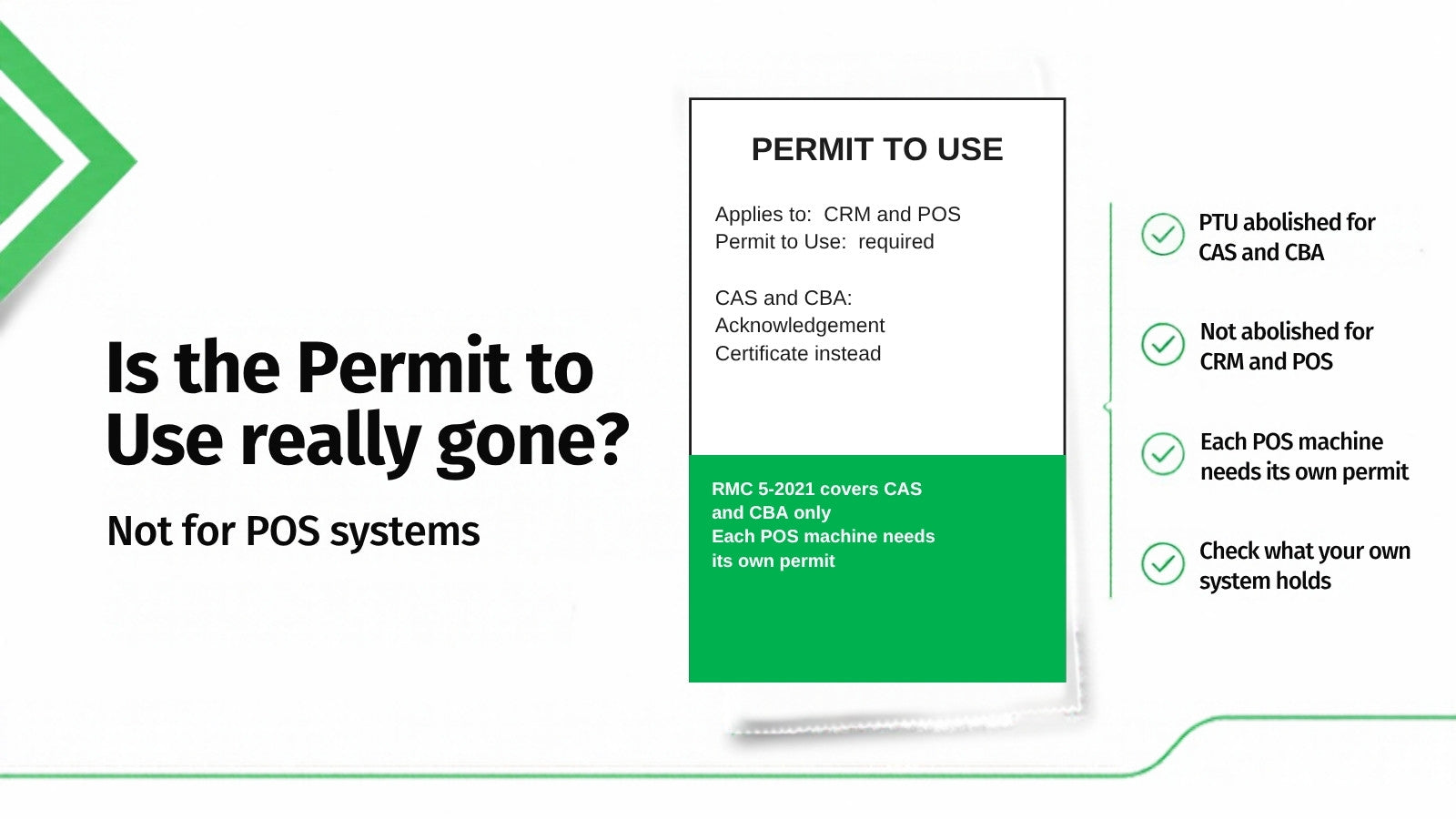
If you have been told the BIR Permit to Use is gone, that is true — for Computerized Accounting Systems. It is not true for Cash Register Machines and POS Systems, which are governed by a different regulation entirely.
This distinction gets blurred in a lot of published guidance, and it matters, because acting on the wrong one means either chasing paperwork you do not need or skipping paperwork you do.
There are three separate BIR regimes in play. Here is what each one actually covers.
The short version
| Your situation | What governs it | What gets issued |
|---|---|---|
| Using a CAS or CBA (accounting system, books of accounts) | RMC 5-2021 | Acknowledgement Certificate — no Permit to Use required |
| Using a CRM or POS System | RMO 24-2023 | Machine accredited via eAccReg; the Permit to Use still appears in the rules |
| Supplying/selling POS systems | RMO 24-2023 | Certificate of Accreditation with an Accreditation Number |
Where the "PTU is abolished" claim comes from
It comes from Revenue Memorandum Circular No. 5-2021, issued 8 January 2021. Its own subject line defines its scope:
"…the simplified policies on the application for registration of Computerized Accounting System (CAS), Computerized Books of Accounts (CBA) and/or its components, including Electronic Storage System (ESS), middleware and other similar systems…"
And the operative change:
"All taxpayers intending to use CAS, CBA and/or its components… shall not be required to secure PTU…"
An Acknowledgement Certificate is issued instead, within three working days of complete documents, with the BIR conducting post-evaluation afterwards rather than a demonstration beforehand.
That is a genuine simplification. But read what it applies to. RMC 5-2021 does not mention Cash Register Machines or POS Systems anywhere. It is a CAS regulation.
What actually governs POS systems
Revenue Memorandum Order No. 24-2023, issued 26 June 2023, is the one that covers point of sale. Its scope:
"…the accreditation of Cash Register Machines (CRMs), Point-of-Sale (POS) and Other Similar Sales Machines/Software Generating Invoices/Receipts including Electronic Invoicing or Electronic Receipting System/Software used under a Subscription-Based Agreement."
And it explicitly excludes the CAS regime — the covered list ends with "except Computerized Accounting System."
Two years after RMC 5-2021 supposedly retired the PTU, RMO 24-2023 refers to it repeatedly. It appears in the receipt-footer requirements, which mandate printing:
"PTU Number and the Date Issued or Authority to Generate (ATG) Control Number (whichever is applicable)."
And in the revocation provisions:
"Revocation of the Accreditation of the developer/distributor… does not necessarily mean that the Permit to Use (PTU) issued to the taxpayer-user of the system is automatically revoked."
RR 7-2024 (11 April 2024) does the same thing a year later still, stating that renaming an Official Receipt to an Invoice on a CRM/POS "shall not require the reaccreditation of sales software/system on the part of the software supplier nor the reissuance of the Permit to Use on the part of the taxpayer-user."
The same regulation uses "Acknowledgement Certificate" in the very next passage — but for CAS and CBA users. Two different instruments, two different populations, one paragraph apart. That adjacency is probably where much of the confusion originates.
Special Purpose Machines: PTU, but no accreditation
There is a third case that is often missed. RMO 24-2023 carves out Special Purpose Machines — equipment used internally or issuing only supplementary documents:
- Automated Teller Machines, and ATMs with cash depository
- Foreign exchange machines
- Ordering machines
- Bills payment machines
- Price checking machines
- Inventory checking and maintenance machines
- Lottery terminals and ticketing machines
These are not subject to accreditation, but they are required to register for the issuance of a Permit to Use through the Enhanced eAccReg System.
So a business running both a POS and a self-service ordering kiosk may be dealing with accreditation for one and a Permit to Use for the other.
Five common setups, and what each one needs
The regimes are easier to see against real configurations.
A single-branch restaurant running one POS terminal. The POS falls under RMO 24-2023 — the machine and its supplier are accredited, and the taxpayer holds a Permit to Use for the machine. No CAS is involved, so RMC 5-2021 does not apply. Monthly eSales reporting is due under RMO 12-2012.
A retail chain running POS terminals and a separate accounting system. Two regimes at once. The POS terminals sit under RMO 24-2023. The accounting system, if it qualifies as a CAS, sits under RMC 5-2021 and needs an Acknowledgement Certificate rather than a Permit to Use. Neither displaces the other.
A café with a POS and a self-service ordering kiosk. The POS is accredited. The ordering kiosk is a Special Purpose Machine — it does not issue the principal invoice — so it is not accredited, but it does require a Permit to Use through eAccReg. One business, two different instruments.
A pharmacy that bought its POS from a reseller. The reseller route is legitimate. The reseller applies for accreditation of a system already accredited to a related company, submitting a Sworn Statement to that effect, and a Certificate of Accreditation is issued within seven working days with the demonstration waived. What matters to the buyer is which certificate their machine is actually covered by.
A business whose vendor pushed a major software upgrade last quarter. Accreditation is tied to a specific software version. A major enhancement — added functionality, new reports, a database platform change — requires a new application for accreditation with a comparative feature matrix. Worth asking whether that was done, or whether the change was classified as minor.
Two things worth knowing about accreditation itself
It is free. RMO 24-2023 states it directly:
"Application for Accreditation of 'Sales Machines/Software' is for 'FREE'. No charge/fee shall be imposed by any Region/LT Office/RDO."
If you have seen a per-device accreditation fee quoted somewhere, check it against the regulation. Accreditation itself carries no BIR charge, and it is free by operation of the Ease of Doing Business Act.
It is version-specific, and it expires. The Certificate of Accreditation:
"…shall reflect an Accreditation Number (AN) for a particular machine brand/model/system/software version…"
And a previously accredited system that undergoes "major enhancements/upgrades/modifications" must file a new application for accreditation, with a comparative matrix of features between the old and new versions. Added functionality, new reports, improved validations and database platform changes all count as major. Minor changes — rearranging fields in the interface, transparent security controls — need only a notification to your RDO.
This is why "is your POS BIR-accredited?" is not quite the right question. The sharper one is: is the specific version you are running covered, and is the accreditation still within its validity period?
How to check what your own system holds
You do not have to take a vendor's word for it. RMO 24-2023 requires that every invoice or receipt the system generates print, at the bottom:
"Name, Address and TIN with 5-digit Branch Code of the accredited supplier of sales machines; Accreditation number and the date of accreditation (date issued and valid until) of the accredited supplier; and PTU Number and the Date Issued or Authority to Generate (ATG) Control Number."
Pull a receipt from your own machine and look at the bottom. The supplier's accreditation number and its validity dates should be printed there. If they are absent, that is worth raising with whoever supplied the system.
Why the confusion persists
Three reasons, and knowing them helps you read other guidance critically.
The change was real, just narrower than reported. RMC 5-2021 genuinely removed a burdensome requirement. Coverage of it compressed "the PTU is abolished for CAS users" into "the PTU is abolished," and the shortened version travelled further than the accurate one.
The instruments appear side by side in the same regulations. RR 7-2024 refers to the Permit to Use for CRM/POS users and to the Acknowledgement Certificate for CAS/CBA users within a few lines of each other. Read quickly, that looks like one thing replacing another rather than two regimes running in parallel.
Nothing has publicly contradicted it. We could not locate any 2025 or 2026 issuance that either extends the CAS treatment to POS or restates the PTU requirement for POS in isolation. In the absence of a correction, an inaccurate summary simply persists — and gets copied.
For that reason this article is deliberately dated and sourced to specific documents rather than stated as a permanent truth. If a later issuance changes the position for CRM and POS, the right response is to update the page, not to defend it.
Where each process happens
Two BIR systems come up, and they are not interchangeable:
- eAccReg — the Enhanced Electronic Accreditation and Registration System. This is where suppliers and taxpayer-users enrol, where accreditation applications for CRM/POS are filed, and where Special Purpose Machines are registered for a Permit to Use.
- ORUS — the Online Registration and Updating System, used for taxpayer registration and updating more broadly.
Applications for accreditation are filed with the LT Office or Revenue District Office where the applicant's Head Office is registered — not where each branch or machine happens to sit. For a multi-branch business, that single detail saves a lot of misdirected paperwork.
Timeline of the relevant issuances
| Date | Issuance | What it did |
|---|---|---|
| 18 Jan 2012 | RMO 12-2012 | eSales reporting guidelines for CRM/POS users |
| 8 Jan 2021 | RMC 5-2021 | Removed the PTU requirement for CAS/CBA; introduced the Acknowledgement Certificate |
| 26 Jun 2023 | RMO 24-2023 | Revised accreditation rules for CRM/POS; still references the PTU |
| 11 Apr 2024 | RR 7-2024 | EOPT invoicing changes; OR → Invoice; still references the PTU for CRM/POS |
| 13 Jun 2024 | RR 11-2024 | Amended the transitory deadlines under RR 7-2024 |
Frequently asked questions
Is the Permit to Use abolished? For CAS and CBA users, yes — RMC 5-2021 replaced it with an Acknowledgement Certificate. For CRM and POS users, the PTU continues to appear in RMO 24-2023 and RR 7-2024, both issued after RMC 5-2021.
What is the difference between accreditation and a Permit to Use? Accreditation applies to the machine or software and, under RMO 24-2023, to the supplier who distributes it. A Permit to Use is issued to the taxpayer for the machine they operate. They are different instruments held by different parties.
Does the BIR accredit POS vendors, or only the machines? RMO 24-2023 requires "all suppliers/vendors/developers/providers/taxpayer-users" to enrol in eAccReg and apply for accreditation. The resulting Certificate of Accreditation carries an Accreditation Number tied to a specific brand, model, system and software version.
How long does accreditation take? Twenty working days from complete documentary requirements and system demonstration. Seven working days for a reseller or distributor of an already-accredited system, where the demonstration may be waived.
My vendor upgraded my software. Does the accreditation still hold? Not automatically. RMO 24-2023 requires a new application for accreditation after major enhancements, upgrades or modifications, including added functionality and added reports.
Where do I verify any of this? RMC 5-2021, RMO 24-2023 and RR 7-2024 are published on bir.gov.ph. Read them directly — including in preference to this article.
This article summarises Revenue Memorandum Circular No. 5-2021 (8 January 2021), Revenue Memorandum Order No. 24-2023 (26 June 2023), and Revenue Regulations No. 7-2024 (11 April 2024) as published by the Bureau of Internal Revenue. It is general information, not tax or legal advice. Confirm your own position with your accountant or Revenue District Office.
Alex de Leon is the President and Co-Founder of KwikPOS, a leading POS solutions provider in the Philippines specializing in one-time-payment systems for food and beverage, retail, and service businesses.
Last reviewed: 3 September 2026.
Related reading
The Permit to Use and accreditation are different instruments held by different parties — BIR POS accreditation, and why it costs nothing covers the supplier side. And if you are wondering about the newer electronic-invoicing rules, do you actually have a 31 December 2026 deadline? is the place to start.
Not sure what your machine is actually registered under?
KwikPOS supplies point-of-sale hardware and software to Philippine retail, food and beverage and service businesses, with onsite implementation and PH-based support. Request a quote or book a demo to go through your own setup.
This article is general information, not tax or legal advice. Confirm your own obligations with your accountant or Revenue District Office. Regulations are linked to the Bureau of Internal Revenue’s own published PDFs so you can check the wording yourself.