
Do You Have a 31 December 2026 E-Invoicing Deadline?
If your business runs a POS system, probably not — and a lot of what has been written about this gets it wrong.
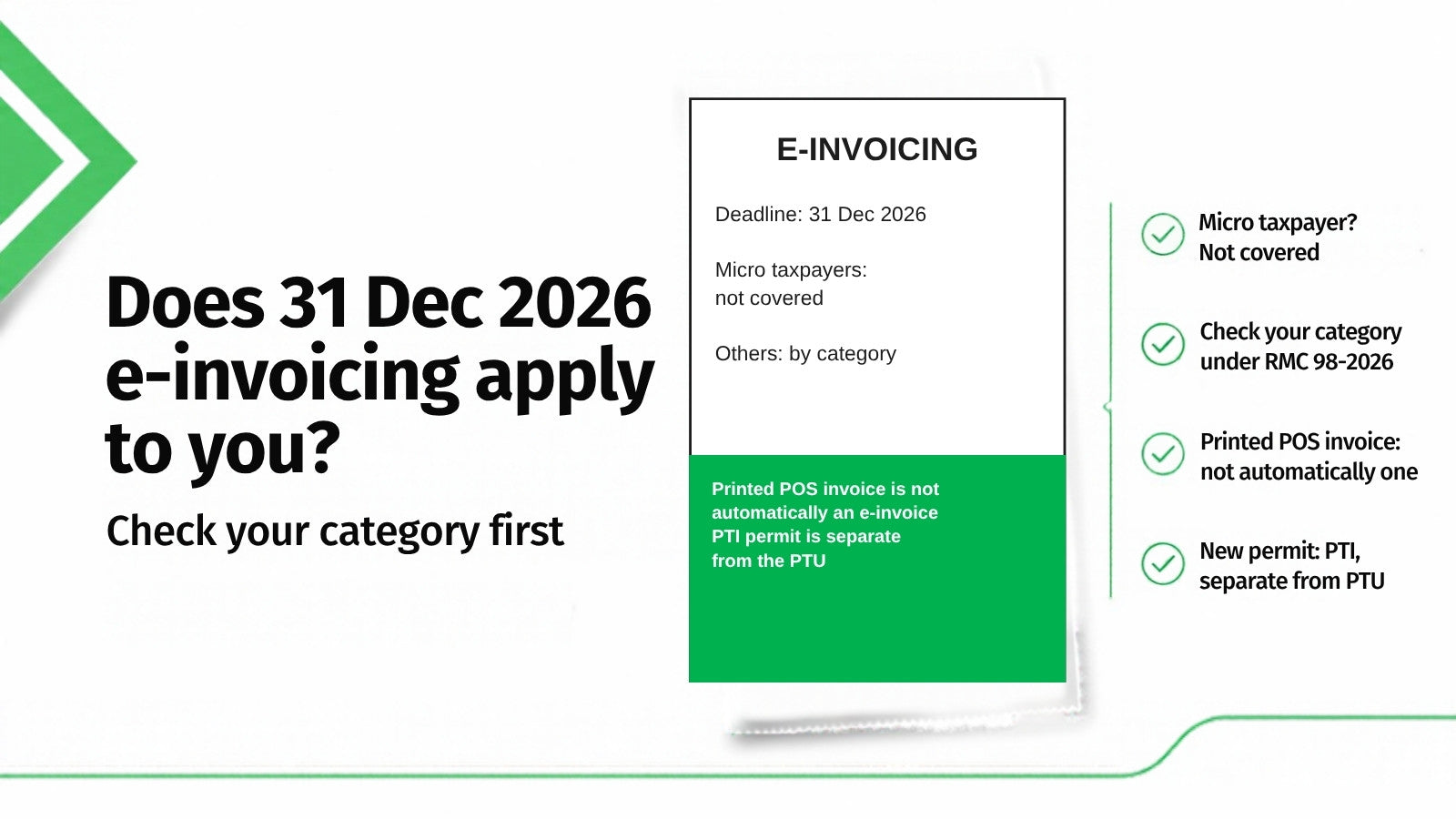
The 31 December 2026 deadline is real, but it applies to four specific groups of taxpayers. Businesses using POS systems are in a different group, one that becomes covered only after the BIR builds the receiving system and issues a separate regulation. No date has been set for that.
Here is how to work out which side of the line you are on.
What RR 26-2025 actually says
Revenue Regulations No. 26-2025, issued 16 October 2025, amended the transitory provisions of RR 11-2025 and extended the compliance period. It splits covered taxpayers into two groups.
Group 1 — must comply by 31 December 2026
"The following taxpayers shall have until December 31, 2026 to comply with the electronic invoicing requirements (issuance of electronic invoices) prescribed in these Regulations:"
- Taxpayers engaged in e-commerce or internet transactions, classified as Small, Medium and Large (Micro taxpayers are exempted)
- Taxpayers under the jurisdiction of the Large Taxpayers Service (LTS)
- Taxpayers classified as Large Taxpayers under RA 11976 and RR 8-2024
- Taxpayers using CAS, and CBA with Accounting Records (with electronic invoicing) and other invoicing software
Group 2 — no deadline set
"Once a system capable of storing and processing the required data to be transmitted to the BIR is established, the following taxpayers shall be required to issue electronic invoices, as may be prescribed through the issuance of separate Revenue Regulations."
- Exporters under Sections 106 and 108 of the Tax Code
- Registered Business Enterprises availing of incentives under Section 304(D)
- Taxpayers using POS System
- Other taxpayers as may be required by the Commissioner
Two conditions have to be met before Group 2 is covered: the BIR must establish a capable system, and it must issue separate Revenue Regulations. Neither has happened.
RR 11-2025 uses the same construction — "Upon establishment by the BIR of a system capable of storing and processing the required data…" — followed by the same list, with "g. Taxpayers using POS System."
The catch that matters most
Group membership is not about what equipment you own. It is about what kind of taxpayer you are — and the categories overlap.
A restaurant running a POS system is in Group 7. But if that same restaurant is also "engaged in electronic commerce or internet transactions" and is classified Small or above, Group 1 applies to it as well — and Group 1 has a date.
This is the single most consequential ambiguity in the current rules for Philippine F&B and retail, because so many businesses now take orders online in some form. RR 26-2025 does not define where the boundary sits between a business that runs a website and a business "engaged in e-commerce."
If you take any meaningful share of orders online, do not assume Group 7 covers you. Put the question to your Revenue District Office in writing and keep the answer. We are not able to resolve it from the published regulations, and neither can anyone else who is honest about it.
A decision path
Work down this list. The first one that matches you is your answer.
| Check | If yes |
|---|---|
| Are you under Large Taxpayers Service jurisdiction? | Group 1 — 31 Dec 2026 |
| Are you classified a Large Taxpayer under RR 8-2024 (gross sales ≥ ₱1 billion)? | Group 1 — 31 Dec 2026 |
| Do you use a CAS or CBA with electronic invoicing? | Group 1 — 31 Dec 2026 |
| Are you engaged in e-commerce or internet transactions and classified Small, Medium or Large? | Group 1 — 31 Dec 2026 ⚠️ see the ambiguity above |
| Are you a Micro taxpayer (gross sales under ₱3,000,000)? | Exempt from mandatory electronic invoicing |
| Do you use a POS System and none of the above apply? | Group 7 — no deadline set |
Classification thresholds come from RR 8-2024 (11 April 2024):
| Class | Gross sales for the taxable year |
|---|---|
| Micro | less than ₱3,000,000 |
| Small | ₱3,000,000 to less than ₱20,000,000 |
| Medium | ₱20,000,000 to less than ₱1,000,000,000 |
| Large | ₱1,000,000,000 and above |
What to do in each case
If you are in Group 1 (31 December 2026). You have a fixed date and it is close. The work is not only buying a capable system — it is having sales and invoice data actually transmitting in the required structured form, which takes configuration, testing and staff process changes. Start from your classification: confirm in writing with your RDO which basis puts you in Group 1, because the remediation differs depending on whether it is your LTS status, your size, your CAS, or your online sales.
If you are in Group 7 and confident about it. You have no deadline, but you do have a choice. Moving voluntarily gets you the RR 11-2025 deduction — 100% of setup cost for Micro and Small taxpayers — and lets you do the transition on your own schedule rather than against a date set for you. Moving later means doing it when everyone else is, with the same suppliers and the same integrators.
If you genuinely cannot tell which group you are in. This is a common and reasonable position, particularly for businesses with an online ordering channel. Write to your RDO describing your actual operations — sales channels, classification, systems in use — and ask which group applies. Keep the reply. A documented position from your RDO is worth considerably more than an assumption, in either direction.
What changes when Group 2 is activated
It is worth understanding what the trigger actually is, because "no deadline" is not the same as "no plan required."
Two things have to happen: the BIR must establish a system "capable of storing and processing the required data to be transmitted to it," and it must issue separate Revenue Regulations prescribing the requirement for these taxpayers. When those regulations arrive, they will carry their own compliance period — and, on the pattern of RR 11-2025 and RR 26-2025, that period is likely to be measured in months rather than years.
The practical implication: the lead time you get will be the length of that future transitory period, not the years of notice it might feel like today. Businesses that have already moved will not be affected. Businesses that have not will be doing the work at the same moment as every other POS user in the country.
What "no deadline" does not mean
Being in Group 7 removes one obligation. It does not remove the others, and this is where businesses get comfortable and then get caught.
Still required regardless:
- Machine accreditation. Your POS must be accredited under RMO 24-2023 before use. Unaffected by any of the above.
- eSales reporting. Under RMO 12-2012, monthly sales reports per machine are due on the 8th of the following month if the last digit of your 9-digit TIN is even, and the 10th if it is odd — "with or without sales transactions."
- Correct invoicing. Under RR 7-2024, the Invoice is now the primary document, not the Official Receipt. RR 11-2024 is explicit that documents still headed "Official Receipt" after the transition are "not… valid for claim of input tax by the buyer/purchaser."
And one thing to understand about your current system: RR 11-2025 states that invoices generated by a POS and "subsequently printed on paper for issuance to buyers, without the capability or readiness to electronically report the sales and invoice data, shall not qualify as electronic invoices." A POS that prints but cannot transmit is, in the BIR's terms, issuing manual invoices. That is fine today if you are in Group 7. It stops being fine when Group 2 is activated.
If you are a Micro taxpayer
Micro taxpayers — gross sales under ₱3,000,000 — get the clearest position of anyone, and it is worth stating plainly because it is frequently misreported.
RR 11-2025 exempts Micro taxpayers from the requirement to issue electronic invoices. The regulation states that in the absence of an electronic invoice they "shall issue a registered manual invoice," and adds that they "may also use CAS, CRM, and POS System, in lieu of electronic invoices."
Note the two consequences. A Micro taxpayer may run a POS without being pulled into the electronic invoicing requirement — and running a POS does not remove the exemption. RR 26-2025 reinforces this by carving Micro taxpayers explicitly out of the e-commerce group: Group 1 covers e-commerce taxpayers "classified as Small, Medium and Large," with "(Micro Taxpayers are exempted)" stated in the text.
Exempt from the requirement is not excluded from the benefit. A Micro taxpayer who voluntarily sets up electronic sales reporting sits in the highest deduction band — 100% of setup cost under RR 11-2025.
One caution: classification is based on gross sales for a taxable year, so it can change. A business that crosses ₱3,000,000 moves from Micro to Small, and the e-commerce exemption stops applying to it. If you are growing through that threshold, the exemption you rely on this year may not be available next year.
The argument for moving early anyway
There is a concrete financial reason not to wait for a deadline.
RR 11-2025 grants an additional deduction from taxable income for setting up an electronic sales reporting system — 100% of the cost for Micro and Small taxpayers, 50% for Medium and Large — in addition to the ordinary Section 34(A)(1) deduction. Importation of such a system is exempt from taxes.
Crucially, the deduction is extended to taxpayers "who voluntarily complied." You do not have to be mandated to claim it.
So the position for a Group 7 business today is: not required to act, but eligible for the full deduction if you do. When the separate regulations for Group 2 eventually arrive, that choice will no longer be voluntary — and the deduction will be being claimed by everyone at once.
Frequently asked questions
Is e-invoicing mandatory in the Philippines right now? For four groups, it becomes mandatory on 31 December 2026: e-commerce taxpayers classified Small and above, LTS taxpayers, Large Taxpayers, and CAS/CBA users. For taxpayers using POS systems, it is not yet mandatory and no date has been set.
When is the deadline for POS users? None has been set. RR 26-2025 requires both that the BIR establish a capable receiving system and that it issue separate Revenue Regulations before that group is covered.
I am a Micro taxpayer. What applies to me? RR 11-2025 exempts Micro taxpayers from issuing electronic invoices. You may issue a registered manual invoice, and the regulation permits using CAS, CRM or a POS System in lieu of electronic invoices.
My restaurant takes orders through a website and delivery apps. Which group am I in? Possibly both. If you are "engaged in e-commerce or internet transactions" and classified Small or above, Group 1 and its 31 December 2026 date may apply to you even though you run a POS. The regulations do not define the boundary. Confirm with your RDO in writing.
Does this change anything about BIR accreditation of my POS? No. Accreditation under RMO 24-2023 is a separate requirement and is unaffected.
Was the deadline extended? Yes. RR 26-2025 (16 October 2025) extended the compliance period for Group 1 to 31 December 2026.
Where can I read RR 26-2025? It is published on bir.gov.ph. Note the full-text version is a scanned document; the Digest version is text-searchable.
This article summarises Revenue Regulations No. 26-2025 (16 October 2025), No. 11-2025 (27 February 2025), No. 8-2024 (11 April 2024), No. 7-2024 and No. 11-2024, and Revenue Memorandum Orders No. 24-2023 and No. 12-2012, as published by the Bureau of Internal Revenue. It is general information, not tax advice. Confirm your own classification and obligations with your accountant or Revenue District Office.
Alex de Leon is the President and Co-Founder of KwikPOS, a leading POS solutions provider in the Philippines specializing in one-time-payment systems for food and beverage, retail, and service businesses.
Last reviewed: 3 September 2026.
Related reading
E-invoicing is a separate obligation from accreditation. BIR POS accreditation, and why it costs nothing explains what your machine and supplier need today, whichever group you fall into. For the system itself, offline POS reliability covers what happens to transmission when the connection drops.
Reviewing whether your POS is ready for what comes next?
KwikPOS supplies point-of-sale hardware and software to Philippine retail, food and beverage and service businesses, with onsite implementation and PH-based support. Request a quote or book a demo to go through your own setup.
This article is general information, not tax or legal advice. Confirm your own obligations with your accountant or Revenue District Office. Regulations are linked to the Bureau of Internal Revenue’s own published PDFs so you can check the wording yourself.