
BIR POS Accreditation: How It Works, and Why It Costs Nothing
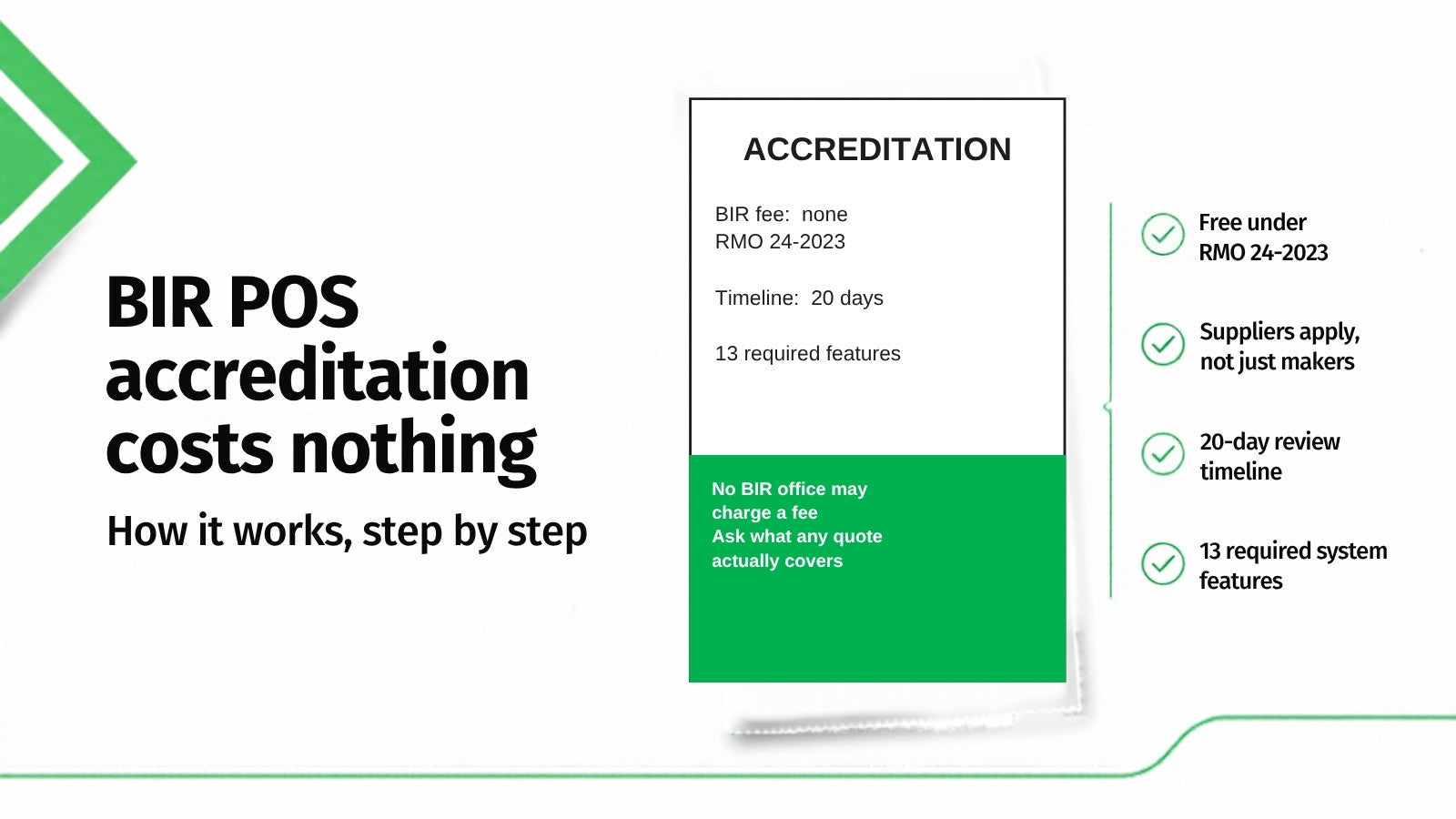
BIR accreditation of a POS system is free. The regulation says so in those words: no charge or fee may be imposed by any BIR office. If you have been quoted an accreditation-related cost, it is worth asking what specifically it covers.
Accreditation is governed by Revenue Memorandum Order No. 24-2023, issued 26 June 2023. It covers what gets accredited, who applies, what the system must be able to do, and how long it takes. Here is the whole process, cited to the order itself.
What has to be accredited
RMO 24-2023 covers all sales machines and software that generate invoices or receipts to record sales transactions:
- Cash Register Machines (CRM)
- POS Systems — both bundled POS (hardware and software) and POS software on its own
- E-invoicing or e-receipting systems used under a subscription-based agreement
- Other similar machines and software issuing printed invoices or receipts — taximeters, handheld or mobile devices linked to a server, and unmanned bill, coin or token-operated machines
Computerized Accounting Systems are excluded. CAS falls under a separate regime — see our explainer on the Permit to Use and the Acknowledgement Certificate.
The exception: Special Purpose Machines
Machines used solely for internal purposes, or that generate only supplementary documents, are not accredited — but they do require a Permit to Use through the Enhanced eAccReg System:
ATMs and cash depository machines, foreign exchange machines, ordering machines, bills payment machines, price checking machines, inventory checking machines, and lottery or ticketing terminals.
A business running a POS alongside a self-service ordering kiosk may therefore be dealing with accreditation for one and a Permit to Use for the other.
Who applies
Not just manufacturers. RMO 24-2023 is broad:
"All suppliers/vendors/developers/providers/taxpayer-users who intend to distribute/sell/use 'Sales Machines/Software' shall apply for enrollment in the Enhanced eAccReg System by submitting a Sworn Declaration to the LT Office/RDO where such supplier/vendor/developer/provider/taxpayer-user is registered."
The order also captures what it calls a "pseudo" supplier, which "shall likewise apply for accreditation of its machines/software."
So the obligation reaches the vendor, the developer, the reseller and — in the relevant cases — the business using the system.
The process, step by step
1. Enrol in the Enhanced eAccReg System. Submit a Sworn Declaration to the LT Office or RDO where you are registered.
2. Apply for accreditation. Once enrolment is approved by email, complete the Application for Accreditation online in eAccReg and submit the documentary requirements manually to the RDO where the applicant's Head Office is registered.
3. Attest to the system's features. The required specifications must be "explicitly attested and declared by the taxpayer through a duly signed and notarized Sworn Statement."
4. Demonstrate the system. A Technical Working Group evaluates it through a system demonstration. The TWG Secretariat coordinates scheduling within three working days of receiving complete documents, on a "FIRST IN, FIRST OUT" basis. The demonstration may be conducted online.
5. Receive the Certificate of Accreditation — or a Notice of Denial stating the reasons.
How long it takes
| Situation | Time to certificate |
|---|---|
| Standard application | 20 working days from complete documentary requirements and system demonstration |
| Reseller or distributor of an already-accredited system | 7 working days — the demonstration may be waived |
The reseller route requires a Sworn Statement declaring that a related company — affiliate, subsidiary, branch, franchisee, reseller or distributor — already holds accreditation for exactly the same machine or software.
What it costs
Nothing. The order states it plainly:
"Application for Accreditation of 'Sales Machines/Software' is for 'FREE'. No charge/fee shall be imposed by any Region/LT Office/RDO."
This follows from the Anti-Red Tape and Ease of Doing Business legislation (RA 9485 / RA 11032), which also sets the statutory processing periods within which the certificate or denial must be issued.
A vendor may of course charge you for their own work in preparing and lodging an application. That is a service fee, and it is worth being clear which one you are being quoted.
What the system must be able to do
To qualify, the machine or software must have the specifications set out in Section IV(5) of the order. The thirteen required capabilities are:
- Accumulated grand total sales
- Tamper-free design
- Activity and transaction log
- Non-volatile memory
- Electronic journal / audit journal
- Sales readings
- Backend reports
- Sequential series of accountable forms
- Reprint functionality
- "Push" functionality
- Verification and validation seal
- Data retention
- Sales data transmission
Note items 10 and 13. The ability to push and transmit sales data is part of accreditation, which is why the electronic sales reporting rules under RR 11-2025 build on the same capability rather than introducing something new.
What those requirements mean in practice
The list above is the regulation's language. Here is what each one is actually asking of the system, which is more useful when you are evaluating one:
| Requirement | What it means operationally |
|---|---|
| Accumulated grand total sales | A running lifetime sales total the system maintains and never resets — the figure the BIR uses to detect gaps |
| Tamper-free | Sales records cannot be edited or deleted after the fact; corrections have to be made as new, traceable entries |
| Activity and transaction log | Every action is recorded — voids, refunds, discounts, price overrides, who performed them and when |
| Non-volatile memory | Records survive power loss. A system that loses the day's transactions in a brownout does not qualify |
| Electronic journal / audit journal | A complete electronic record of every document issued, retrievable for audit |
| Sales readings | X-reading (a running total without resetting) and Z-reading (an end-of-day close that resets the daily counter) |
| Backend reports | Reports the BIR can inspect — sales summaries, void and discount reports, senior citizen and PWD discount reports |
| Sequential series of accountable forms | Invoice numbering runs in unbroken sequence; the system cannot skip or reuse numbers |
| Reprint functionality | A reissued document is clearly marked as a reprint so it cannot pass as a second original |
| "Push" functionality | The system can send its data outward to the BIR rather than only waiting to be read |
| Verification and validation seal | A mechanism confirming the data has not been altered in transit or storage |
| Data retention | Records are kept for the period the Tax Code requires, and remain retrievable |
| Sales data transmission | The system can transmit sales data to the BIR in the required form |
Two of these — the Z-reading and the senior citizen / PWD discount reporting — are where most day-to-day compliance friction actually occurs in Philippine retail and F&B, because they are used every single day and any gap shows up immediately in an audit.
What to ask before you buy
If you are evaluating a system, these are the questions that establish its accreditation position — rather than the general "is it BIR-compliant?", which invites a yes without telling you anything:
- What is the Accreditation Number, and what are its issue and validity dates? These appear on the Certificate of Accreditation and are printed on every receipt the system produces.
- Which brand, model, system and software version does that certificate cover? Accreditation attaches to a specific version, not to the company.
- Is the version you are quoting me the version on the certificate? If the vendor has shipped upgrades since accreditation, ask whether those were minor enhancements or whether re-accreditation was required.
- Who applied — you, or a company you resell for? The reseller route under RMO 24-2023 is legitimate, but you should know whose certificate you are relying on.
- Will the accreditation still be valid over the life of my deployment? Certificates carry an end date.
- Does the system do Z-reading and SC/PWD discount reporting the way the BIR requires? These are the daily-use functions.
None of these are unreasonable questions, and a vendor holding a current certificate can answer all six from documents they already have.
What must be printed on every receipt
This is the part worth knowing as a buyer, because it makes a vendor's accreditation independently checkable.
RMO 24-2023 requires the following at the bottom of every Official Receipt, Sales Invoice or Charge Invoice the system produces:
"Name, Address and TIN with 5-digit Branch Code of the accredited supplier of sales machines; Accreditation number and the date of accreditation (date issued and valid until) of the accredited supplier; and PTU Number and the Date Issued or Authority to Generate (ATG) Control Number (whichever is applicable)."
Pull a receipt from your own machine and look at the bottom. The supplier's accreditation number and its validity dates should be printed there. If they are missing, ask.
Accreditation is version-specific, and it expires
Two features of the certificate that are widely misunderstood.
It is tied to a version. The Certificate of Accreditation "shall reflect an Accreditation Number (AN) for a particular machine brand/model/system/software version." Accreditation attaches to a specific build, not to a company in perpetuity.
Major changes require a new application. Any previously accredited system that undergoes "major enhancements/upgrades/modifications" must file a fresh Application for Accreditation, submitting "a comparative matrix of the functions and/or features between the previously accredited 'Sales Machines/Software' and its upgraded/modified/enhanced version." A new certificate is issued on approval.
Major changes include additional functionality, improved field and batch validations, additional reports and a change of database platform. Minor changes — rearranging fields in the user interface, transparent security controls — need only a notification to the RDO.
And the certificate has an end date. The receipt-footer rule above requires printing "date issued and valid until", which tells you accreditation is time-limited on its face.
The practical question for a buyer is therefore not "is this vendor accredited?" but "is the version I am being sold covered, and is that accreditation still valid?"
How accreditation can be revoked
RMO 24-2023 lists the grounds, which are worth knowing because they indicate what the BIR is actually policing:
- Tampering with the Certificate of Accreditation
- Misrepresentation in the Sworn Statement by the supplier
- Tampering with sales data
- Use of sales suppression software
- Any violation of the policies and procedures, and of RR 11-2004
One useful clarification in the order: revocation of a developer's or distributor's accreditation "does not necessarily mean that the Permit to Use (PTU) issued to the taxpayer-user of the system is automatically revoked." The two instruments are held by different parties and stand or fall separately.
That separation cuts both ways for a business. It means a supplier's problem does not automatically invalidate your permission to operate the machine you bought — but it also means the supplier's accreditation status is not something you can simply assume is being maintained on your behalf. The accreditation number and validity dates printed on your receipts are the practical check.
Sales suppression software is worth singling out from that list. It refers to tools designed to delete or alter recorded sales so that revenue disappears from the audit trail — sometimes called zappers or phantomware. Its inclusion as an explicit revocation ground indicates how seriously the BIR treats the integrity requirements above, and it is the reason several of the thirteen features exist: the accumulated grand total, the tamper-free requirement, the audit journal and the validation seal all exist to make suppression detectable.
Frequently asked questions
How much does BIR POS accreditation cost? Nothing. RMO 24-2023 states the application is free and that no charge may be imposed by any Region, LT Office or RDO.
How long does BIR accreditation take? 20 working days from complete documents and system demonstration; 7 working days for a reseller or distributor of an already-accredited system.
Does the BIR accredit the vendor or the machine? Both are involved. Suppliers, vendors, developers and providers apply for accreditation, and the certificate issued carries an Accreditation Number tied to a specific machine brand, model, system and software version.
Do I need accreditation if my machine is only for internal use? Special Purpose Machines that do not generate sales invoices or receipts are not accredited, but they must be registered for a Permit to Use through eAccReg.
My vendor upgraded my software. Is it still accredited? Not automatically. Major enhancements require a new application with a comparative feature matrix.
How can I check whether a POS is really accredited? Look at the bottom of a receipt it produces. RMO 24-2023 requires the accredited supplier's name, address, TIN, accreditation number and validity dates to be printed there.
Does accreditation mean I do not need a Permit to Use? They are separate. Accreditation concerns the machine and its supplier; a Permit to Use is issued to the taxpayer operating it.
This article summarises Revenue Memorandum Order No. 24-2023 (26 June 2023) as published by the Bureau of Internal Revenue, with reference to RR 11-2004 and RR 11-2025. It is general information, not tax or legal advice. Confirm your own obligations with your accountant or Revenue District Office.
Alex de Leon is the President and Co-Founder of KwikPOS, a leading POS solutions provider in the Philippines specializing in one-time-payment systems for food and beverage, retail, and service businesses.
Last reviewed: 3 September 2026.
Related reading
Accreditation sits alongside the practical side of buying a system. How to choose POS hardware in the Philippines covers terminals, printers and scanners, and how POS requirements differ by business type sets out what a food service, retail or service counter each needs.
Buying a POS and want the paperwork handled properly?
KwikPOS supplies point-of-sale hardware and software to Philippine retail, food and beverage and service businesses, with onsite implementation and PH-based support. Request a quote or book a demo to go through your own setup.
This article is general information, not tax or legal advice. Confirm your own obligations with your accountant or Revenue District Office. Regulations are linked to the Bureau of Internal Revenue’s own published PDFs so you can check the wording yourself.